Accounting for arborists business involves tracking income from tree services – whether you call yourself an arborist or tree lopper – managing equipment-heavy operational costs, allocating overhead accurately across jobs, and maintaining compliance with tax obligations specific to trade-based operations. The goal is clear visibility into which jobs generate profit, how equipment costs affect margins, and where cash flow requires attention during seasonal fluctuations.
Understanding the Five Core Account Types
Every arborist business operates through five fundamental account categories that form the foundation of financial tracking.
Income represents revenue from tree removal, pruning, stump grinding, storm work, and consulting services. Each service line should be tracked separately to identify which work generates the strongest returns.
Expenses divide into two critical groups: direct job costs and overhead. Direct costs include crew wages, fuel, equipment wear, disposal fees, and materials used on specific jobs. Overhead covers office expenses, insurance premiums, marketing, software subscriptions, and administrative wages that support the entire operation.
Assets hold value within the business. Cash in bank accounts, accounts receivable from completed jobs, trucks, chippers, stump grinders, chainsaws, climbing gear, and inventory all qualify as assets. Equipment represents the largest asset category for most tree care operations.
Liabilities reflect amounts owed to external parties. Equipment loans, lines of credit, accounts payable to suppliers, payroll liabilities, and tax obligations fall into this category.
Equity measures ownership value in the business. This includes initial capital invested, retained earnings from profitable years, and owner draws taken from the business.
These five account types work together through journal entries that record every financial transaction, creating a complete picture of business performance.
Building a Chart of Accounts for Tree Care Operations
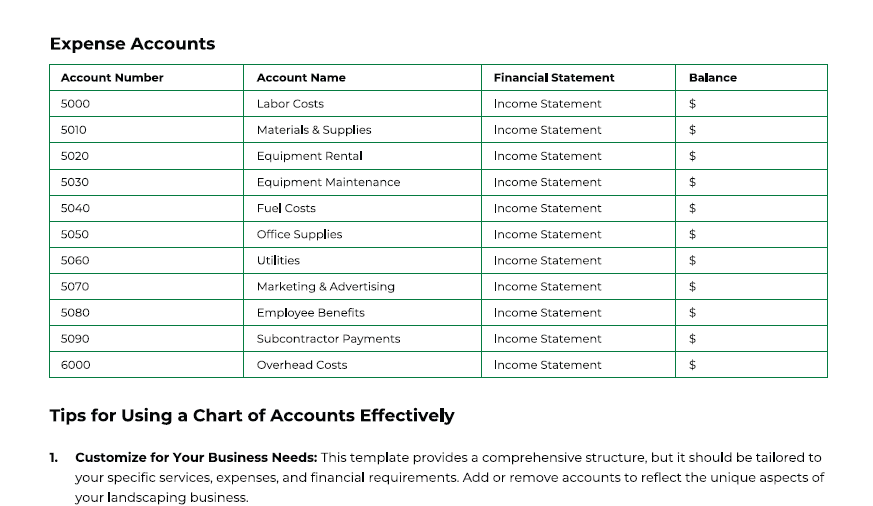
A properly structured chart of accounts organizes financial data in ways that support decision-making rather than creating confusion.
Income Accounts
Income accounts should be separated by service type:
- Tree removal
- Pruning and trimming
- Stump grinding
- Emergency storm work
- Consulting and reports
- Equipment rental (if applicable)
This separation reveals which services drive revenue growth and which may require pricing adjustments.
Cost of Goods Sold Accounts
Track direct job expenses separately:
- Crew wages and payroll taxes
- Subcontractor payments
- Fuel and vehicle maintenance
- Equipment repairs
- Disposal and dump fees
- Climbing supplies and consumables
- Safety equipment
Overhead Expense Accounts
Capture everything else that supports operations:
- Office salaries
- Rent and utilities
- Insurance (general liability, workers’ compensation, vehicle)
- Software and technology
- Marketing and advertising
- Professional development and certifications
- Administrative supplies
Asset, Liability, and Equity Accounts
Asset accounts monitor value storage: checking and savings accounts, accounts receivable, bucket trucks and utility vehicles, chippers and grinders, chainsaws and hand tools, climbing and rigging gear, and inventory.
Liability accounts track obligations: equipment loans and leases, credit cards and lines of credit, accounts payable, payroll tax liabilities, and deferred revenue.
Equity accounts show ownership position: owner capital, retained earnings, and owner draws.
Organize this structure in accounting software from day one. QuickBooks, MYOB, or Xero can accommodate this framework, making monthly financial reviews straightforward rather than complicated.
Job Costing: The Profit Engine for Tree Services
Job costing determines whether individual tree service projects generate profit or drain resources. Without accurate job costing, pricing remains guesswork and margins erode quietly over time.
Tracking Direct Labour
Start by tracking direct labour hours for each job. Record crew time separately from equipment operation time. A three-person crew spending six hours on a large oak removal represents 18 labour hours that must be captured and costed correctly.
Calculate fully loaded labour costs by including base wages, payroll taxes, workers’ compensation premiums, and superannuation. A crew member earning $28 per hour might actually cost $42 per hour when all employment expenses are loaded onto base wages.
Allocating Equipment Costs
Equipment costs require careful allocation. Fuel consumption, blade replacements, chipper wear, and truck maintenance tie directly to job activity. Calculate equipment cost per hour by dividing monthly equipment expenses by the hours of active use. Apply this rate to each job based on actual equipment deployment.
For example, a chipper costing $400 per month in combined expenses operating 80 hours monthly generates a $5 per hour rate. Apply this rate to every job based on actual equipment deployment time.
Materials and Disposal Costs
Materials and disposal costs attach directly to jobs. Dump fees, wood chips, stump grinding consumables, and rigging supplies all flow into job cost calculations. Keep disposal receipts organized by job number for accurate tracking.
Overhead Allocation
Overhead allocation completes the job costing picture. Calculate your monthly overhead rate by dividing total overhead expenses by practical capacity hours. If monthly overhead runs $12,000 and your crews can practically work 400 billable hours, your overhead rate equals $30 per hour. Apply this rate to every job based on crew hours to ensure overhead recovery.
Job Costing Formula:
Direct Labour + Equipment Cost + Materials + (Overhead Rate × Crew Hours) = Total Job Cost
Subtract total job cost from job revenue to reveal actual profit per project. This level of detail shows which service types generate strong margins and which consume resources without adequate returns. A pruning job might show a 35% margin, while emergency storm work reveals only a 12% margin after accounting for all costs.
For detailed guidance on implementing job costing systems, review our Outsourced Finance Function services.
Equipment Depreciation and Asset Management
Equipment represents the largest capital investment for arborist businesses. Proper accounting for these assets affects tax obligations and replacement planning.
Understanding Depreciation Methods
Depreciation spreads equipment costs over useful life rather than expensing purchases entirely in the year acquired. A bucket truck purchased for $85,000 with a seven-year useful life depreciates approximately $12,000 annually using straight-line depreciation. This creates a consistent expense that reflects true equipment costs over time.
Different depreciation methods exist:
- Straight-line depreciation divides the cost evenly across years
- Accelerated depreciation front-loads expenses to earlier years, reducing taxable income sooner
The method chosen affects tax planning and should align with your accountant’s recommendations for your business setup.
Equipment Maintenance Tracking
Track equipment maintenance separately from depreciation. A maintenance log showing hours operated, repairs completed, and costs incurred reveals when equipment approaches replacement thresholds. When annual repair costs exceed 40% of equipment replacement value, replacement decisions require evaluation.
Equipment Utilization
Equipment utilization tracking shows productivity. Hours operated divided by available hours reveals the utilization percentage. A chipper operating 600 hours annually at 70% utilization generates more value than one operating 300 hours at 35% utilization. This data informs equipment expansion or reduction decisions.
Learn more about financing equipment strategically through our Equipment Finance guide.
Tax Compliance and Record-Keeping Requirements
Arborist businesses face multiple tax obligations that require organized record systems.
GST Registration and BAS Lodgement
GST registration becomes mandatory when the annual turnover exceeds $75,000 in Australia. Register early if purchasing expensive equipment to claim GST credits on these acquisitions. Track GST collected on services rendered and GST paid on business purchases separately. Business Activity Statements (BAS) are lodged quarterly for most small operations, reporting net GST position to the Australian Taxation Office.
PAYG Withholding
PAYG withholding applies when hiring employees. Withhold tax from wages based on tax tables, report through Single Touch Payroll, and remit withheld amounts quarterly. Subcontractor payments may require PAYG withholding depending on contract structure and ABN status.
Taxable Payments Annual Report (TPAR)
Taxable Payments Annual Report (TPAR) requires businesses paying subcontractors for tree services to report these payments annually when services represent 10% or more of revenue. Track subcontractor ABNs, total payments, and service descriptions throughout the year for accurate TPAR lodgement.
Income Tax by Business Structure
Income tax obligations vary by business structure:
- Sole traders report business income on individual tax returns
- Companies lodge separate returns and may distribute franked dividends
- Trusts pass income to beneficiaries who report on individual returns
Each structure carries different compliance requirements and tax planning opportunities. Understanding which structure best suits your operations is critical, learn more in our Business Setup guide.
Record Retention
Record retention follows ATO guidelines. Keep all receipts, invoices, bank statements, and financial records for five years minimum. Digital storage through receipt capture apps or cloud accounting platforms simplifies compliance while protecting against document loss.
For comprehensive tax compliance support, explore our Tax Compliance services designed specifically for arborist operations.
Pricing Strategy Based on True Costs
Accurate accounting reveals true service costs, enabling confident pricing decisions.
Calculating Fully Loaded Labour Costs
Calculate your fully loaded labour cost by adding base wages, payroll taxes, workers’ compensation premiums, and superannuation. A crew member earning $28 per hour might cost $42 per hour when all employment expenses are loaded onto base wages.
Adding Equipment Costs
Add equipment cost per hour using the calculation method described earlier. Factor in fuel, maintenance reserves, insurance, and depreciation to arrive at the total equipment cost per operating hour.
Including Overhead Recovery
Include overhead recovery in every quote. The overhead rate calculated from your chart of accounts must be applied to estimated job hours, ensuring fixed costs receive coverage from every project.
Building in Profit Margin
Built-in profit margin after covering all costs. A 20% profit margin on a $3,000 job adds $600 to the quote, providing business sustainability beyond cost recovery.
Compare your pricing against local market rates while understanding your cost structure. Charging below cost to win work creates business failure regardless of volume. Price confidently based on your numbers, adjusting service mix if margins prove insufficient.
Discover how benchmarking your business reveals pricing gaps and helps optimize your quote-to-win ratio.
Software and Technology for Arborist Accounting
The right software stack transforms accounting from a burden into a strategic tool.
Accounting Platforms
Accounting platforms like Xero provide cloud-based bookkeeping, bank feed reconciliation, invoicing, and financial reporting. QuickBooks offers similar functionality with strong integration options. MYOB serves Australian businesses with local tax compliance features built directly into the platform.
Industry-Specific Platforms
Industry-specific platforms like ArboStar and Arborgold combine job management, scheduling, estimating, and accounting in unified systems. These platforms understand tree service workflows, equipment tracking, and crew management needs specific to arboriculture.
Field Service Platforms
Field service platforms like Jobber handle mobile estimating, payment processing, customer communications, and basic job costing. Integration with accounting software creates data flow from field operations to financial records without manual re-entry.
Receipt Capture Tools
Receipt capture tools like Dext and Hubdoc photograph receipts, extract transaction data, and push information directly into accounting platforms. This eliminates paper receipt storage while maintaining compliant records.
Choose software based on business complexity. Solo operators manage well with QuickBooks and receipt capture. Multi-crew operations benefit from integrated platforms that connect field work to financial systems seamlessly.
Cash Flow Management for Seasonal Operations
Tree service businesses experience seasonal revenue fluctuations that require proactive cash management.
Building Cash Flow Forecasts
Build a 12-month cash flow planning showing expected income by month and required expense payments. Identify months where cash inflows fall short of obligations, allowing advance planning for shortfalls.
Maintaining Operating Reserves
Maintain operating reserves equal to three months of overhead expenses. This buffer covers slow periods without forcing unfavourable financing decisions during low-revenue months.
Invoicing and Collections
Invoice promptly after job completion. Delayed invoicing extends payment cycles unnecessarily. Use accounting software to generate invoices immediately when crews complete work.
Offer payment options that accelerate cash collection. Credit card processing, bank transfers, and payment plans reduce accounts receivable days compared to waiting for cheques.
Monitor accounts receivable ageing weekly. Follow up on invoices outstanding beyond payment terms. A systematic collection process prevents cash flow problems from worsening.
Timing Equipment Purchases
Plan equipment purchases during strong cash flow periods rather than when reserves run low. Coordinate major expenditures with seasonal income peaks to avoid cash crunches.
Key Performance Indicators Worth Tracking
Financial metrics guide business decisions when monitored consistently.
| KPI | Calculation | Target Range |
| Gross Margin % | (Revenue – Direct Costs) ÷ Revenue | 30-40% |
| Labour Productivity | Monthly Revenue ÷ Total Crew Days | Track trend |
| Equipment Cost % | Total Equipment Costs ÷ Revenue | 15-25% |
| Average Debtor Days | Accounts Receivable ÷ Avg Daily Revenue | 30-45 days |
| Quote-to-Win Ratio | Won Quotes ÷ Total Quotes | 30-50% |
Gross margin percentage shows profitability before overhead. Calculate by dividing gross profit (revenue minus direct costs) by revenue. Track by service type to identify which work generates the strongest returns.
Labour productivity per crew day measures revenue generated per crew day worked. Divide monthly revenue by total crew days deployed to reveal productivity trends.
Equipment cost as a percentage of revenue indicates whether equipment expenses remain sustainable. Divide total equipment costs by revenue. Percentages above 25% may signal over-investment in underutilized assets.
Average debtor days calculate how long customers take to pay. Divide accounts receivable by average daily revenue. Lower numbers indicate faster cash conversion.
Quote-to-win ratio tracks estimating effectiveness. Divide won quotes by total quotes provided. Low ratios suggest pricing misalignment or ineffective sales processes.
Monitor these metrics monthly to spot trends before they create problems. Declining margins, extending receivables, or falling productivity all signal issues requiring management attention.
Use our Benchmarking service to compare your KPIs against real arborist data from your region and identify improvement opportunities.
When to Engage Professional Accounting Support
Self-managed accounting works for straightforward operations, but complexity eventually demands professional guidance.
Critical Engagement Points
Engage a qualified accountant when:
- Hiring the first employee (payroll compliance, superannuation, and employment obligations introduce liability that requires expert oversight)
- Changing business structures (moving from sole trader to company or establishing trusts carries significant implications for tax, liability, and administration)
- Making equipment financing decisions (loan versus lease analysis, tax implications, and cash flow impact requires financial modelling beyond basic bookkeeping)
- Facing ATO correspondence or audit notices
- Expanding to multiple crews or service areas
Annual Reviews
Schedule annual reviews with your accountant regardless of business complexity. Tax planning opportunities, deduction optimization, and compliance verification provide value that exceeds professional fees.
Outsourced Bookkeeping
Consider outsourced bookkeeping when administrative tasks consume time better spent on operations or growth. Professional bookkeepers maintain records, prepare reports, and handle BAS lodgements, freeing owners to focus on the business.
Explore our full range of accounting and advisory services tailored specifically for arborist businesses across Australia.
Self-Managed Superannuation for Arborists
As your arborist business grows and generates consistent profit, self-managed superannuation funds (SMSFs) offer control over retirement savings and potential tax advantages.
SMSFs allow investment in property, shares, and other assets while maintaining direct oversight. However, they require strict compliance with ATO regulations, annual audits, and detailed record-keeping.
Our SMSF services help arborist business owners set up and manage compliant funds that align with long-term wealth-building goals.
Strategic Growth Through Financial Clarity
Arborist businesses that treat accounting as a strategic function rather than a compliance burden make better decisions, preserve stronger margins, and build more valuable operations over time. The numbers tell the story when tracked properly, recorded accurately, and reviewed regularly.
For businesses ready to scale from one crew to multiple teams, our Growth Advisory services provide the financial frameworks, KPI tracking, and strategic planning needed to grow sustainably.
Frequently Asked Questions about Accounting for Arborists
What accounting method should arborists use, cash or accrual?
Most small arborist businesses use cash accounting, which records income when received and expenses when paid. This method aligns with actual cash flow and simplifies tax reporting. Accrual accounting records transactions when they occur regardless of payment timing, which provides a more accurate picture of profitability but adds complexity. Businesses with inventory or annual turnover over $10 million must use accrual. Consult your accountant to determine which method suits your operations.
How often should I review my arborist business financials?
Review profit and loss statements, cash flow position, and accounts receivable aging at minimum monthly. Weekly reviews provide better operational control during busy seasons. Quarterly reviews should include deeper analysis of job profitability by service type, equipment utilization rates, and progress toward annual financial goals. Annual reviews with your accountant ensure tax compliance and identify structural improvements.
Can I claim tax deductions for equipment that’s used partly for personal purposes?
Yes, but only proportional to business use. Maintain a logbook or usage records documenting business versus personal use for at least 12 continuous weeks. Apply the business use percentage to all related costs including purchase price depreciation, fuel, maintenance, insurance, and registration. For example, a chainsaw used 90% for business and 10% for personal property maintenance claims 90% of all related expenses.
What’s the difference between job costing and general bookkeeping?
General bookkeeping records all business transactions and produces financial statements showing overall profitability. (Not sure if you need a specialist? Compare arborist accountant vs general accountant.) Job costing tracks revenue and expenses for individual projects, revealing which specific jobs or service types generate profit and which lose money. Job costing requires additional detail including crew hours per job, equipment usage per job, and materials consumed per job. This granular data informs pricing decisions and identifies operational inefficiencies that general bookkeeping cannot reveal.
Do I need separate insurance for business vehicles and equipment?
Yes. Personal vehicle insurance typically excludes business use, meaning accidents during tree service work may not be covered. Commercial vehicle insurance covers business operations including employee drivers, equipment in transit, and liability for work-related incidents. Equipment insurance covers specialized assets like chippers, stump grinders, and climbing gear against theft, damage, and breakdown. Separating business from personal insurance ensures proper coverage and supports legitimate tax deductions.
How do I handle warranty work or callbacks in my accounting?
Record warranty work and callbacks as separate jobs with zero revenue and actual costs (labour, fuel, equipment). This creates accurate tracking of rework costs that affect overall profitability. Analyze callback frequency by job type, crew, or time period to identify quality issues requiring training or process improvements. Some businesses create a warranty expense account to track total rework costs as a percentage of revenue, targeting reductions over time.
Should I expense or capitalize tool purchases?
Items under $300 (or your accountant’s recommended threshold) can typically be expensed immediately. Larger purchases require capitalization and depreciation over the asset’s useful life. Chainsaws, harnesses, and small hand tools often qualify for immediate expensing. Chippers, trucks, and stump grinders require depreciation. The instant asset write-off threshold changes periodically, so consult your accountant before making significant purchases to optimize tax treatment.
What records do I need for an ATO audit?
ATO audits require comprehensive documentation including all tax returns, BAS lodgements, bank statements, invoices issued to customers, invoices received from suppliers, payroll records, superannuation payment confirmations, vehicle logbooks, asset registers showing equipment purchases and depreciation, and any correspondence with the ATO. Maintain organized digital or physical files for five years minimum. Missing documentation results in deduction disallowances and potential penalties beyond the original tax shortfall.
How can benchmarking help my arborist business?
Benchmarking compares your financial and operational metrics against similar arborist businesses in your region. This reveals whether your crew productivity, gross margins, equipment costs, quote-to-win ratios, and debtor days are above, below, or on par with industry standards. Benchmarking identifies specific improvement opportunities with quantified targets rather than guessing where problems exist. Our free benchmark report provides immediate insights into your business performance.
What’s the biggest accounting mistake arborist businesses make?
Mixing personal and business finances creates the most severe compliance and operational problems. This includes using personal accounts for business transactions, paying personal expenses from business accounts, or failing to separate owner compensation from business profits. Mixed finances make accurate profit measurement impossible, contaminate tax deductions with personal expenses, create audit exposure, and prevent informed decision-making. Establish separate business banking and credit cards immediately, even as a sole trader, to maintain clear financial boundaries.
Want to get your arborist business finances in order? Discover our full range of accounting and advisory services for arborists designed specifically for tree care professionals.
Related Reading
- Bookkeeping for Arborists: Why Xero or QuickBooks Isn’t Enough Without Setup Support
- Small Business Accountant Tree Services
- Top 5 Tax Mistakes Arborists Make (And How To Fix Them)
Want an accountant who speaks arborist?
We work exclusively with tree care businesses. Every recommendation is backed by industry data and real-world arborist experience.
Book Your Free ConsultationTalk to a specialist arborist accountant
Arbour Advisory works exclusively with arborists, tree loppers and tree care businesses across Australia. Book a free, no-obligation consultation to talk through your tax, bookkeeping, equipment finance or growth questions.
How Arborist Job Costing Actually Works (and Why Most Crews Get It Wrong)
Job costing in an arborist business is the discipline of attaching every dollar of cost to a specific job so you know which jobs make money and which ones bleed. Most operators skip it or guess it, then wonder why their P&L says profit but their bank account says panic.
The five cost buckets every job should carry: direct labour (crew wages including super and workers comp on-cost), equipment hours (chipper, grinder, EWP, truck — charged at an internal rate that covers depreciation, servicing and fuel), materials and consumables (chain, fuel, PPE, dump fees), subcontract costs if you brought in an EWP operator or arborist, and a share of overhead recovery. Sum those five, compare to the invoice value, and you have true job margin.
The trap most businesses fall into is under-charging equipment hours. A chipper that cost $80,000 and services at $6,000 a year needs to recover roughly $45 an hour before it breaks even. If your quote assumed the chipper was free because “it is paid off”, you just gave the client a $45 an hour discount out of your own pocket. Build a per-asset internal hourly rate, plug it into your quoting template, and the problem disappears.
Xero, MYOB and QuickBooks all support basic job costing via tracking categories. For anything beyond a handful of simultaneous jobs, a dedicated tool like WorkflowMax, ServiceM8 or Tradify will save you hours a week.
Frequently Asked Questions
What is a realistic internal hourly rate for a woodchipper?
For a mid-size 6-inch tow-behind chipper bought new at $80-95k, the true internal rate sits between $40 and $55 an hour once you factor in depreciation, servicing, blades, fuel and insurance. Ignore this figure and you will systematically under-quote chipper-heavy jobs.
How often should I review my job costing numbers?
Monthly at minimum, weekly is better. The review should compare actual job margin to quoted margin and flag any job that came in more than 10% under quote. That is your early-warning system for pricing drift, crew inefficiency or a new estimator who is too optimistic.