Over-financing equipment creates high fixed repayments that outpace cash flow, raising repossession risk, negative equity, and operational burnout. For Australian arborists, where a single wood chipper can cost $80,000-$150,000 and elevated work platforms exceed $200,000, the line between strategic investment and financial strain is thinner than most operators realise. This guide explains what actually happens when debt exceeds capacity, how to diagnose whether your current financing is sustainable, and the specific steps to avoid loan burnout while still growing your tree service business.
If you’re considering new equipment or reviewing existing finance arrangements, our equipment finance services can help structure deals that align with your actual cash flow patterns.
The “Gear Trap” in Australian Arboriculture
Over-financing happens for predictable reasons. A large contract comes through requiring specific equipment. A competitor buys a new chipper, and suddenly yours looks outdated. A finance broker approves a loan amount that feels like validation rather than a warning sign.
The approval itself creates false confidence. Lenders assess your ability to repay based on historical income and asset security, not on whether the equipment will generate enough additional revenue to justify the payments. Getting approved for $120,000 doesn’t mean $120,000 of debt makes sense for your operation.
The Cash Flow Reality of Tree Work
Arborist revenue follows patterns that standard loan structures ignore. Storm seasons create income spikes. Winter months slow dramatically in most regions. Council contracts pay on 30-60 day terms, while wages and fuel costs are paid weekly.
A loan structured around consistent monthly payments doesn’t account for months where revenue drops 40% while repayments stay fixed. The mismatch creates pressure that compounds over time.
Hidden Costs Most Owners Miss
The finance quote shows a weekly payment. What it doesn’t show is the total cost of ownership.
A $100,000 chipper financed over five years isn’t a $100,000 decision. Add interest costs ($15,000-25,000, depending on rate), annual insurance ($3,000-5,000), scheduled maintenance ($5,000-8,000 annually for commercial use), compliance inspections, and unplanned downtime when the machine is being serviced. The true five-year cost often exceeds $160,000.
Operators who finance based on the weekly payment rather than the total cost of ownership consistently underestimate their actual obligations.
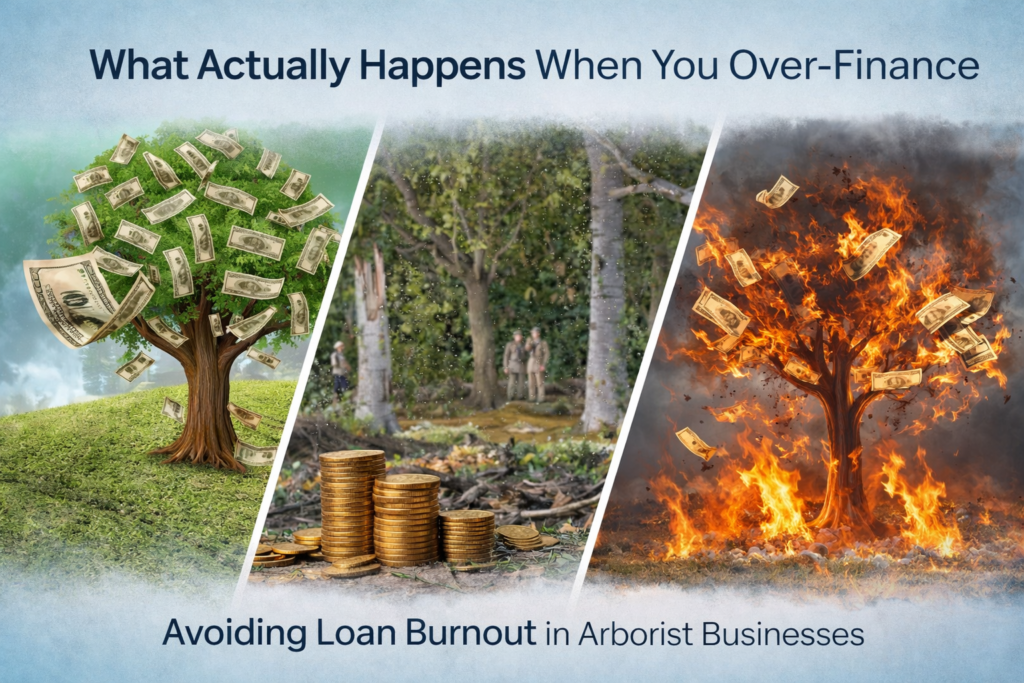
What Actually Happens When You Over-Finance
Repossession of Essential Assets
Most equipment finance is secured against the asset itself. Miss payments and the lender has legal authority to repossess. For an arborist, losing a chipper or truck doesn’t just hurt, it can shut down operations entirely.
Repossession typically occurs after 60-90 days of missed payments, though this varies by lender and contract terms. The process moves faster than most operators expect, and the equipment disappears regardless of jobs already booked.
The Negative Equity Trap
Equipment depreciates faster than most loans amortize. A chipper worth $100,000 new might be worth $65,000 after two years, but if you financed 100% with a balloon payment, you could still owe $75,000.
This creates negative equity, owing more than the asset is worth. If you need to sell due to cash flow problems, you’ll still owe the difference. If the equipment breaks down or becomes obsolete, you’re paying for something you can’t use and can’t sell.
Debt Outlasting Useful Life
A common structuring mistake is selecting loan terms longer than the equipment’s practical life. A five-year loan on a high-use chipper that needs major overhaul or replacement at year four means you’re paying for equipment that’s either broken or gone.
Match loan terms to a realistic, useful life, not to whatever term produces the lowest monthly payment.
Cash Flow Crises
High monthly repayments consume cash that would otherwise cover wages, fuel, insurance, and emergency repairs. When equipment payments eat 35-40% of gross revenue, there’s nothing left for operational flexibility.
The business becomes fragile. One slow month, one unexpected repair, one late-paying client tips the balance from manageable to crisis.
Crew Burnout and Margin Erosion
To cover high debt obligations, over-financed businesses take on more jobs, often at lower margins. The crew works harder, equipment runs longer hours, and per-job profitability drops even as revenue increases.
This creates a trap: working more to earn less, with higher wear on both people and machines. The business looks busy while actually becoming weaker.
Australian Financing Structures and Where They Fit
Understanding the options helps you choose structures that match your situation rather than accepting whatever a broker presents.
| Structure | Ownership | GST Treatment | Best For |
| Chattel Mortgage | Immediate | Claim GST upfront | Established businesses with strong cash flow |
| Hire Purchase | At the end of the term | Claim GST upfront | Businesses wanting an ownership path with fixed payments |
| Operating Lease | Never (return asset) | Claim payments as expense | High-obsolescence equipment or uncertain utilisation |
| Rental/Short-term Hire | Never | Claim as expense | Project-specific needs or cash flow preservation |
When Balloon Payments Help, or Hurt
A balloon (residual) payment reduces monthly obligations by deferring a portion to the end of the term. This can help cash flow during the loan period but creates a lump sum obligation at maturity.
Balloon payments work when you have a clear plan: refinance, sell the asset, or pay from accumulated reserves. They hurt when you assume “something will work out” without a specific strategy.
Seasonal Payment Structures
Some lenders offer seasonal or step payment arrangements where repayments are higher during peak months and lower during off-peak periods. For arborists with predictable seasonality, this alignment reduces cash flow pressure during slow months.
Ask specifically about seasonal structures; they exist but aren’t always presented as standard options.
How to Know Your Debt Is Too High

Financial Thresholds
Debt Service Coverage Ratio (DSCR): Your operating cash flow divided by annual debt service. A DSCR below 1.25 means you’re operating with minimal margin for error. Below 1.0 means you’re not generating enough cash to cover your debt obligations.
Repayment-to-Revenue Ratio: If total equipment repayments exceed 25-30% of gross monthly revenue, you’re likely over-financed. This threshold assumes normal operating expenses; if your other costs are high, the sustainable percentage drops further.
Utilisation Rate: Equipment sitting idle for more than 40% of scheduled working hours isn’t generating enough return to justify finance costs. Calculate whether actual billable hours cover the cost of ownership.
Behavioural Warning Signs
Financial stress shows up in behaviour before it shows up in bank statements.
Missing or delaying ATO payments to cover equipment loans. Using credit cards to cover fuel or wages because the “big payments” consumed available cash. Taking jobs at margins you’d normally reject just to keep revenue flowing. Feeling constant pressure despite being busy.
These patterns indicate debt levels that exceed sustainable capacity, regardless of what the numbers technically show.
Avoiding Loan Burnout: The Playbook
Assess Needs Accurately
Buy for consistent utilisation, not for one large job. If a $150,000 chipper will be fully utilised three days per week across your regular work mix, the investment may make sense. If you’re buying it for a single contract, hoping more work follows, you’re speculating with borrowed money.
Ask: “Would I buy this if the one big job didn’t exist?” If not, consider rental or subcontracting for that specific project.
Evaluate Used vs New
New equipment offers warranty protection and the latest features. Used equipment offers a lower purchase price and smaller finance obligations.
A three-year-old chipper at $65,000 versus a new model at $110,000 changes the entire financial equation. The used machine may require more maintenance, but the $45,000 difference in finance obligations provides significant cash flow breathing room.
Inspect used equipment thoroughly, verify service history, and factor realistic maintenance costs into your comparison.
Structure Deals Around Cash Flow
Choose loan terms shorter than the useful life. Paying off a chipper in four years when it has six years of practical life leaves two years of ownership without payments.
Request seasonal payment structures if your revenue follows predictable patterns. Avoid balloon payments unless you have a specific, funded plan for the maturity date.
Consider larger deposits to reduce ongoing obligations, even if it means waiting longer before purchasing.
Maintain a Cash Buffer
Keep reserves equal to at least three months of equipment repayments plus core operating expenses. This buffer absorbs slow periods, unexpected repairs, and payment timing gaps without creating a crisis.
Building this buffer may mean delaying equipment purchases or choosing less expensive options. The financial stability is worth more than the marginal capability difference.
Calculate the Total Cost of Ownership First
Before accepting any finance quote, calculate the full five-year cost: purchase price plus total interest plus annual maintenance plus insurance plus estimated downtime cost.
Compare this total against realistic revenue projections from the equipment’s utilisation. If the numbers don’t work with honest assumptions, the weekly payment being “affordable” doesn’t matter.
Numbers Arborists Should Know
DSCR Formula: Operating Cash Flow ÷ Annual Debt Service = DSCR Target: 1.25 minimum, 1.50 preferred
Utilisation Break-Even: (Monthly Repayment + Attributable Operating Costs) ÷ Margin Per Billable Hour = Hours Required Monthly
Negative Equity Check: Current Loan Balance – Current Market Value = Equity Position If negative, you owe more than the asset is worth
Safe Repayment Threshold: Total monthly equipment repayments should not exceed 25-30% of average gross monthly revenue
If You’re Already Over-Financed
Recognising the problem is the first step. Options exist even when debt feels overwhelming.
Refinancing: If rates have dropped or your credit position has improved, refinancing can reduce payments or shorten terms. This works best when you have positive equity in the equipment.
Restructuring: Some lenders will extend terms or adjust payment schedules to improve cash flow. This typically costs more over the life of the loan but may provide necessary breathing room.
Asset Sale: Selling over-financed equipment and paying out the loan, even at a loss, may be better than continuing payments on underutilised gear. Calculate whether the ongoing cost exceeds the one-time loss.
Consolidation: Multiple equipment loans can sometimes be consolidated into a single facility with better terms, simplifying management and potentially reducing total obligations.
For a review of your current finance structure and options, our outsourced finance function includes debt analysis and cash flow forecasting.
Protect Your Business Health
Arbour Advisory helps arborists across Australia structure equipment finance that supports growth rather than creating fragility. The goal isn’t to avoid financing, it’s to finance strategically so that equipment investments generate returns that exceed their costs.
Book a finance structure review to assess your current obligations and identify options for sustainable equipment investment.
Frequently Asked Questions about Arborist Equipment Over-Financing
Can taking an equipment loan risk my entire business?
Yes. Secured equipment loans give lenders repossession rights over essential operational assets. Default can shut down your ability to work, creating a cascade that affects all business obligations.
What happens if I miss payments on a secured loan?
Typically, lenders issue notices after 14-30 days, with repossession proceedings beginning around 60-90 days of arrears. The timeline varies by contract and lender, but moves faster than most operators expect.
Is leasing better than buying for seasonal arborist work?
Leasing offers flexibility and preserves capital but costs more over time. For equipment with uncertain utilisation or rapid obsolescence, leasing may reduce risk. For core equipment with predictable high utilisation, ownership often makes more financial sense.
How do I avoid negative equity on equipment?
Limit finance terms to less than the asset’s practical useful life, make deposits where possible to reduce borrowed amounts, and maintain equipment properly to preserve resale value.
Looking at equipment finance options for your arborist business? Learn more about our equipment finance services to find the right structure for your next purchase.
Related Reading
- How Arborists Are Using Equipment Loans to Scale Without Cashflow Risk
- Should You Buy or Finance Your Next Chipper? A Tax-Focused Guide for Arborists
- Cash Flow Planning for Arborists
Talk to a specialist arborist accountant
Arbour Advisory works exclusively with arborists, tree loppers and tree care businesses across Australia. Book a free, no-obligation consultation to talk through your tax, bookkeeping, equipment finance or growth questions.