Benchmark ratios payroll vs revenue tree firms is the key number that shows if your labor spend is healthy. It asks one simple question: for every dollar you bring in, how many cents go to payroll for production crews and support staff. When you track this each week and each month, you spot problems early, set fair prices, and plan hiring with less stress.
Many owners rely on “feel.” That is risky. A few big storm jobs can hide weak weeks. Clear math beats guesswork. This guide explains the standard range for a tree company, how to calculate your own ratio, and what to change if your payroll is eating too much of your sales.
What the ratio includes
Your payroll number should include crew wages, overtime, employer payroll taxes, basic benefits, and any temp labor tied to jobs. You can track office pay in a second line, or include it if your office team is small. Do not include owner draws, major equipment loans, or dump fees in this ratio. Those belong in other buckets.
Simple formula you can use
Payroll to Revenue Ratio = Payroll Cost ÷ Revenue
If payroll is 45,000 and revenue is 120,000, your ratio is 45,000 ÷ 120,000 = 0.375 (37.5%).
Healthy benchmarks by company type
No two firms are the same, but most steady tree companies land inside a narrow band when jobs, pricing, and scheduling are under control.
Small crews (1–2 trucks, 3–8 field staff)
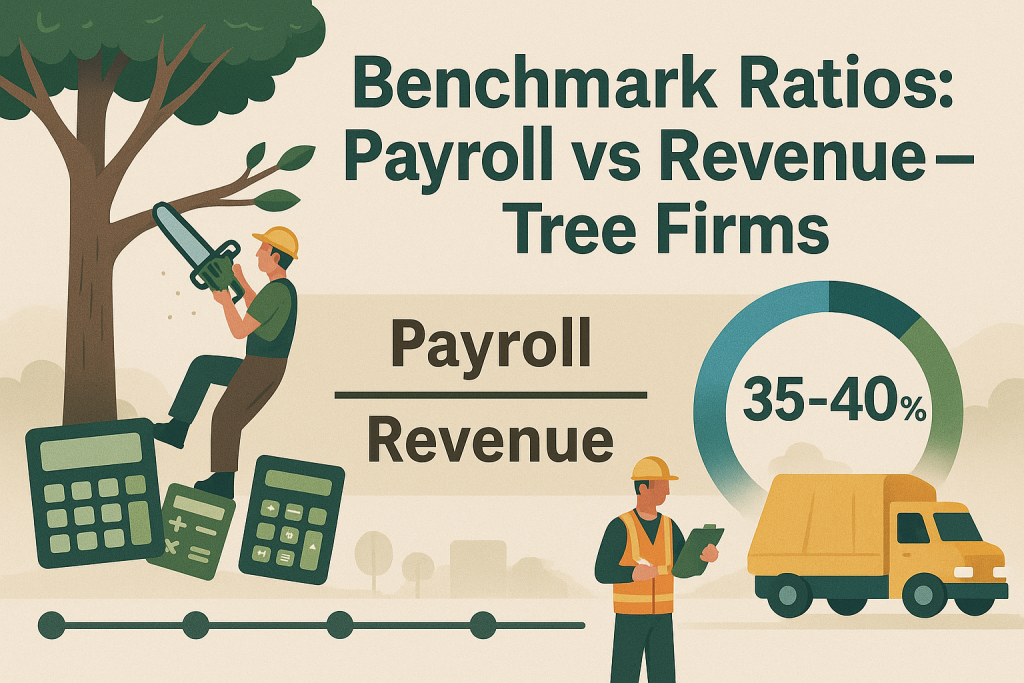
A common healthy range is 33% to 40%. Below 33% can mean prices are high for your market or the owner is not on payroll. Above 40% often means too much idle time, long drive routes, or underbidding.
Mid-size firms (3–6 trucks, 9–25 field staff)
Targets often sit between 35% and 42% because you now carry a dispatcher, sales support, or shop help. Good routing and strong close rates keep you near the low end. Weather gaps and weak estimating push you up.

Large firms and municipal work
Ranges can be 36% to 45% depending on union rules, benefits, training time, and lower-margin public bids. Tight scheduling, clear safety systems, and repeat contracts help hold the line.
Why ratios drift in tree service
Tree work has real swings: storms, permit waits, machine breakdowns, and long hauls to dump. When one part slips, payroll hours rise while sales do not. That is how a healthy 38% week becomes a 48% week. Your job is to spot it fast and fix the cause, not the symptom.
Set up clean tracking
Use one job code for each crew day. Log drive time, setup, cutting, rigging, haul, and shop time. Put dump and fuel on the same job. At week’s end, your software or sheet should show hours and pay per job and day. With clean inputs, your ratio report writes itself.
Price for the hours you truly spend
Many bids miss small steps that eat time: hard access, traffic control, stump roots, or small roof repairs after removal. Add those minutes to the bid. Small misses times ten jobs becomes a full day of unpaid labor. When bids match real time, payroll stays in range.
Quick rule of fit
If your truck is parked more than it is cutting, your price is wrong or your route is weak. Fix one or both before you hire.
Schedule to kill idle time
Back-to-back jobs in the same area keep saws running and crews fresh. Long hops burn wages in traffic. Group jobs by zip or zone. Start with high-risk jobs early in the day. Save low-risk pruning for late slots. If weather hits, you can still finish something and protect the day’s revenue.
Control overtime the smart way
Overtime is not bad when it finishes a big day and avoids a second trip. It is bad when poor staging or late permits cause late starts. Track why overtime happens. If the reason is “truck was loaded late” three times in a week, your fix is in the yard, not in payroll cuts.
Equipment choices that lower payroll percentage
A compact loader, a mini skid, or a small crane rental can change the math. If a loader saves one hour for a three-person crew, that is three wage-hours saved. Over a month, the loader payment is covered and your ratio falls. Test on a few jobs. Keep the tool only if the time saved is real and repeatable.
Train for speed and safety
Clear hand signals, saw care, and rope systems turn tough removals into smooth ones. Safety tailgates are not “extra time.” They prevent injuries and rework that blow up payroll and claims. Ten focused minutes at dawn can save two hours and a hospital bill at noon.
Read the ratio by day, week, and month
Daily gives you fast feedback. Weekly shows patterns by crew and service type. Monthly tells the big story and smooths storms and holidays. If a crew sits high three weeks in a row, ride along. You will find the leak.
When to raise prices
If your ratio stays above your target for six straight weeks and you already fixed routing and staging, raise prices on the next ten bids by a small step. Track close rate. If close rate holds, keep the new price.
Simple ways to bring a high ratio down
Start work on time. Stage tools and sharp chains the night before. Cut drive time by zoning the calendar. Match crew size to the job; too many people can slow a small removal. Use photos and short videos to prove change orders when scope grows. Bill the time you actually spend. Each step moves the dial a little; together they move it a lot.
When the ratio is too low
A very low ratio can feel great—until gear breaks or people leave. If payroll drops under 30% for months, check if you are understaffed, skipping training, or pushing unsafe pace. The goal is a healthy, steady number, not the lowest number.
Profit map that fits tree firms
Your gross margin needs to cover fuel, dump, repairs, insurance, marketing, rent, and profit for growth. A stable payroll ratio is the core of this map. When payroll sits near target, you can predict cash, plan upgrades, and say yes to the right work.
A simple weekly dashboard
Keep one page that shows revenue, payroll cost, payroll ratio, close rate, average job size, overtime hours, and rework hours. Meet for ten minutes each Monday. Celebrate any crew that hit target with safe days. Pick one fix for the new week and test it.
Conclusion
Your payroll to revenue ratio tree service number is the clearest view of labor health. Track it with clean hours, price for real time, and schedule to cut idle minutes. Train crews, stage gear, and rent tools that remove wasted steps. When the ratio holds near your target, profit improves, cash stress falls, and your team works safer and happier.
FAQs
What is a good payroll to revenue ratio for a small tree company
Many healthy small firms land between 33% and 40%, depending on market rates, routing, and owner pay setup.
Should office wages be in the ratio
Track field payroll as the core ratio. You can add a second line for office wages to watch total labor impact.
How often should I measure it
Check daily for fast feedback, weekly for patterns, and monthly for the full picture.
What raises the ratio the most
Underbidding, long drive routes, late starts, rework, and unplanned overtime. Fix routing and staging first.
When do I raise prices
If the ratio stays high for six weeks after you fixed scheduling and staging, increase prices a bit and watch close rates. If close holds, keep the change.
Ready to grow your tree care business strategically? Our growth advisory services for arborists help you benchmark performance, improve pricing, and scale sustainably.
Related Reading
- Arborist Business Benchmarking Guide (Australia)
- How to Price Arborist Services for Profit (Not Just Survival)
- Hiring Your First Employee as an Arborist: Payroll, Super, and What the ATO Expects
Need help with arborist payroll and award compliance?
We handle award interpretation, payroll setup, and compliance for tree care businesses.
Book Your Free ConsultationTalk to a specialist arborist accountant
Arbour Advisory works exclusively with arborists, tree loppers and tree care businesses across Australia. Book a free, no-obligation consultation to talk through your tax, bookkeeping, equipment finance or growth questions.